Valeo — Process FMEA for an Assembly Line
An assembly line changed. Its documents hadn't. I rebuilt them
- Context
- Internship · Valeo Tunisie (Ben Arous)
- Role
- Process Engineering Intern, with the line's process engineer
- Period
- Jul–Aug 2025
- Gallery
- Industrial Engineering
The problem
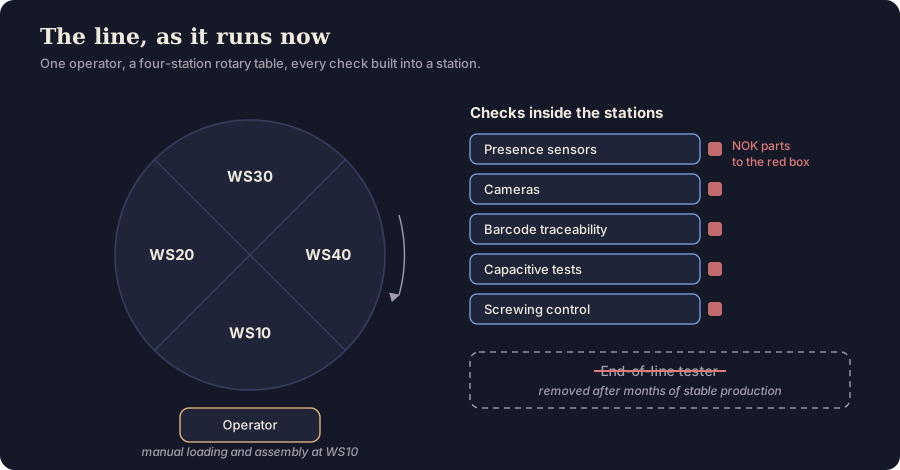
The end-of-line tester came off a capacitive touch-panel assembly line after months of stable production. Its quality documents went on describing a process that no longer existed.
What I built
- Genba first: every station of the four-station rotary table, watched and walked through with the line's process engineer, noting where the documents and the line disagreed.
- A new workstation sheet for the line's single operator, in the site's standard format.
- A new process flow chart: value-added, non-value-added and control steps, each with its standard symbol.
- A complete process FMEA on the AIAG-VDA seven-step method: 30 operations, 133 failure causes traced by 6M, each rated for severity, occurrence and detection and given an action priority.
Inside the decisions
Where the risk sits
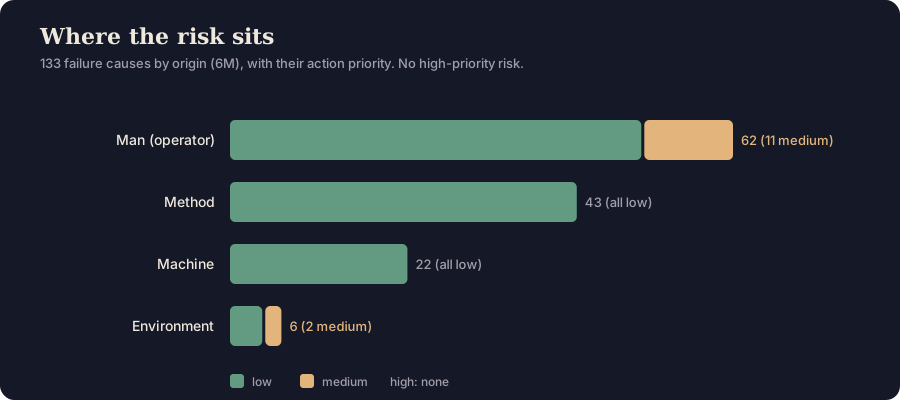
Machines and methods came out clean: all 65 of their failure causes rated low. Every one of the 13 medium risks sits with people (11) or the environment (2).
So the actions went to the operator, not the equipment: an ergonomics review at the manual loading station, and the standards written back into the new workstation sheet.
Why the tester could go
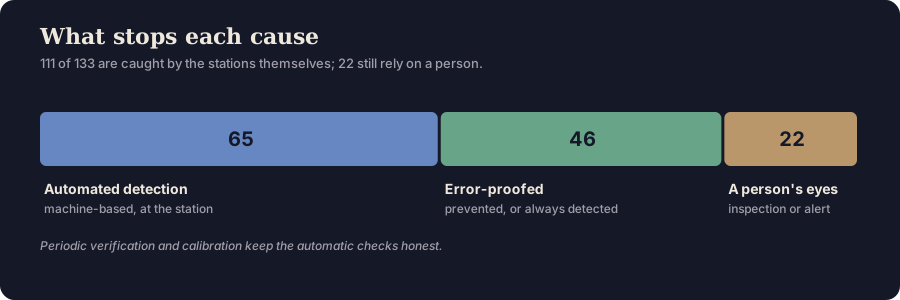
111 of the 133 causes are stopped inside the stations: 65 by automated detection, 46 made impossible or always caught by error-proofing. The other 22 rely on a person's eyes.
Checks built into the process only stay trustworthy if they are themselves checked, so the FMEA adds periodic verification and calibration of the cameras, barcode readers, capacitive testers and screwing control.
The outcome
Three documents that agree with each other and with the line as it runs: no high-priority risk left, and preventive actions aimed at where the remaining risk lives.