Tactical Patcher — A Scout's Desk for Master League
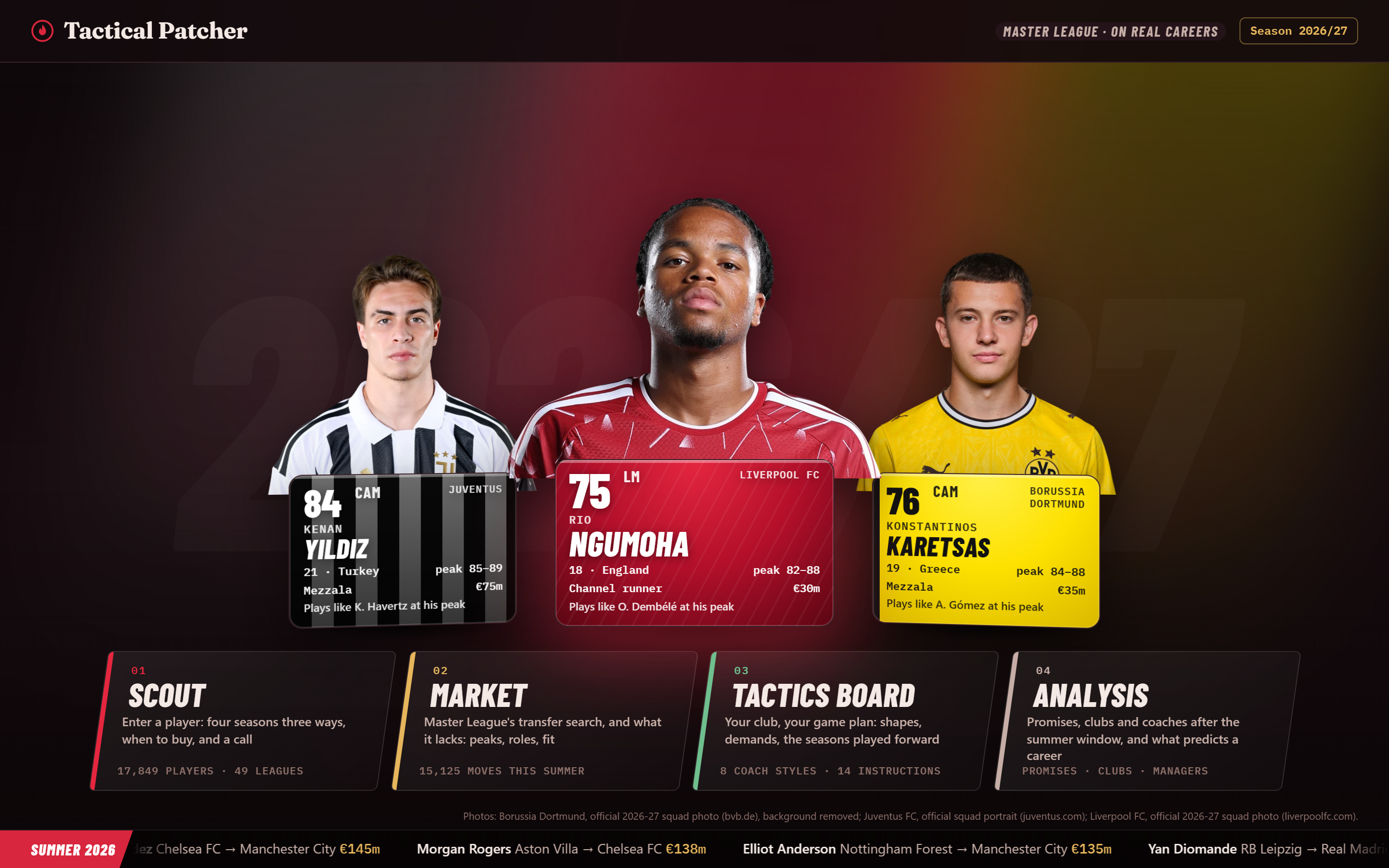
Master League grows every youngster on rails. Real careers don't. A scout's desk built on the real ones
- Context
- Personal project · the stepping stone to Promesse
- Role
- Solo: data, models and app
- Team
- Solo
- Period
- Summer 2026
- Galleries
- Player & Match Modelling, Applied AI Systems
The problem
Master League decides a youngster's future once, then grows him on rails: in real saves almost every 16 to 20-year-old gains five points in two seasons, and decline starts at 27. Real careers split. Some explode, many stall, and what decides it is minutes, the level around the player and the club. A scout needs the range, not one number.
What I built
- Football Life 26's database understood field by field (25 abilities packed as 6-bit values, eight snapshots of the season, 29,413 players), and saved Master League careers read without changing a byte, to measure how the game grows its players.
- One identity per player across EA FC 26 and 27, FIFA 15–23, Football Life and Transfermarkt's 2026 summer window: probabilistic record linkage (Fellegi–Sunter, weights fitted by EM), 82,933 people.
- A growth engine of quantile models (LightGBM: P10, P50 and P90 of next season's change), trained on real season-to-season changes joined to the minutes each player really got.
- A four-season simulator with learned minutes and club moves, its spread calibrated on one time machine (FIFA 18 → 22) and tested on another (FIFA 19 → 23).
- Roles as attribute signatures read on shape rather than level, archetypes from Gaussian mixtures, and a buy-now-or-wait solver: least-squares Monte Carlo over 300 futures, priced by a market-value model.
- A tactics board: a game plan in PES's own terms, read against the eleven's attributes, with demands set on the spread of the big five's elevens.
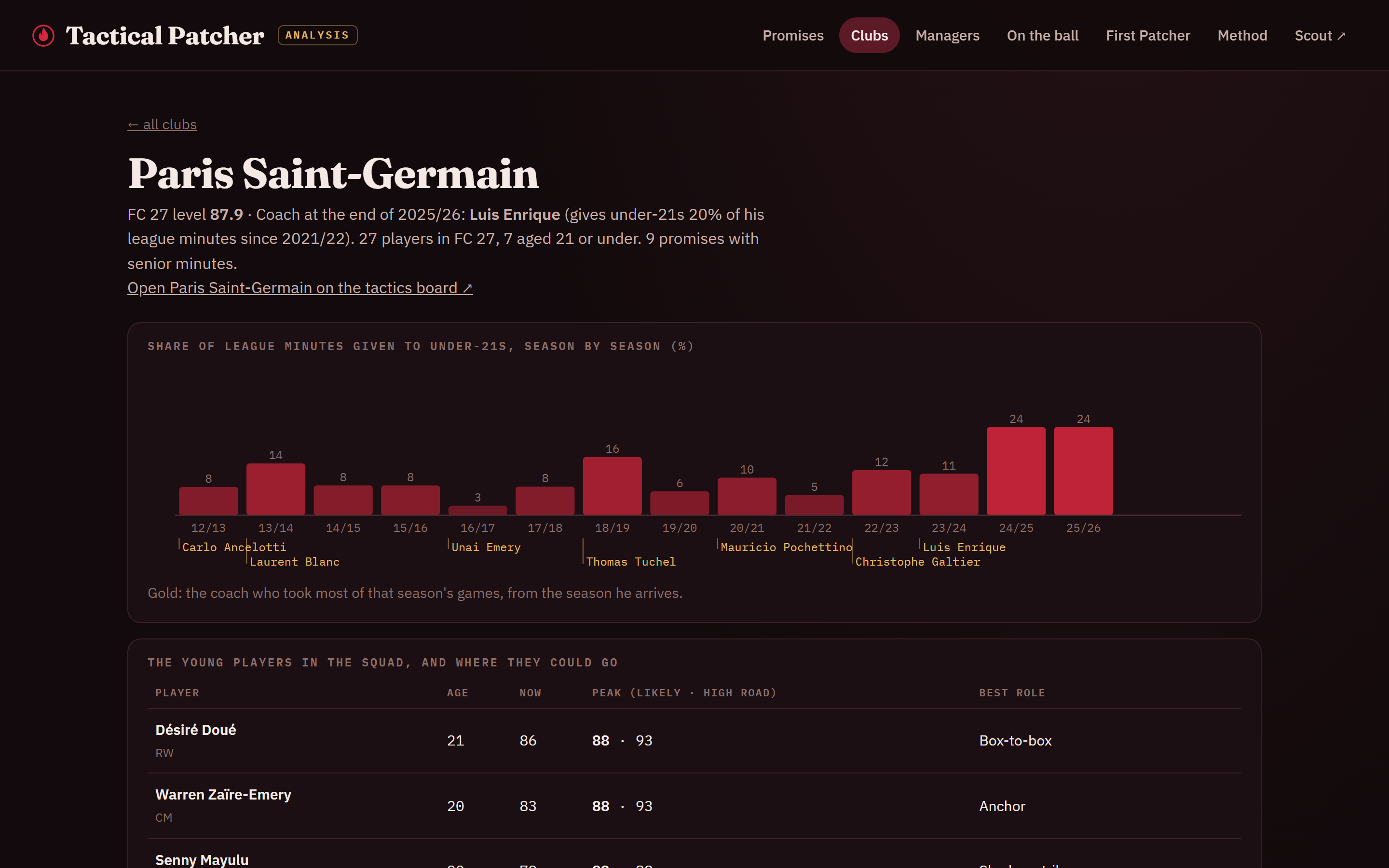
- Analysis pages on the same data: every under-21 promise scored, every club's youth minutes under each coach, every coach's record with youth since 2021/22, all read after the summer 2026 window.
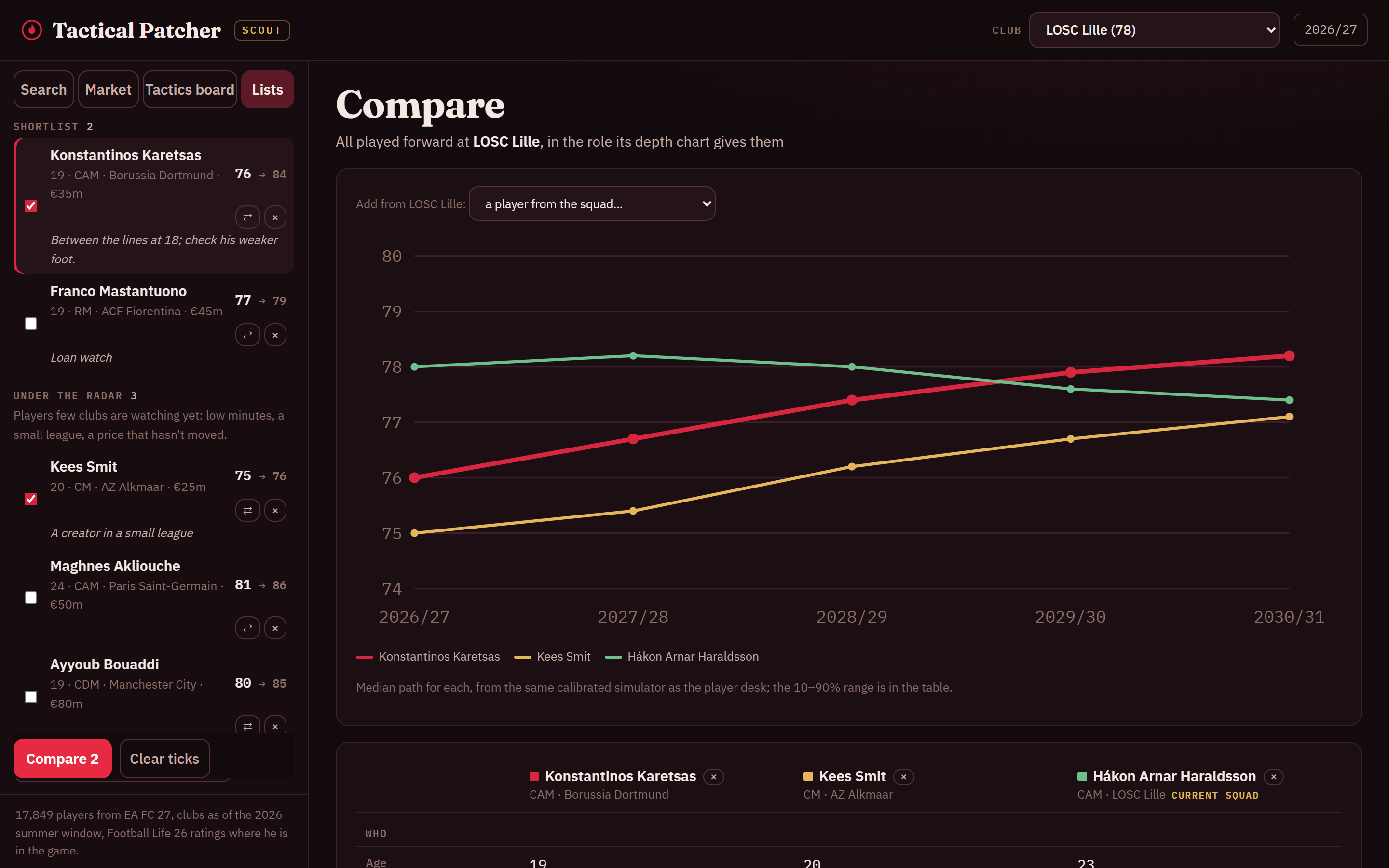
- Scouting lists (a shortlist, and the players under the radar) and a comparison that plays two to four names forward at your club, one of your own players included.
Inside the decisions
Would it have seen the future?
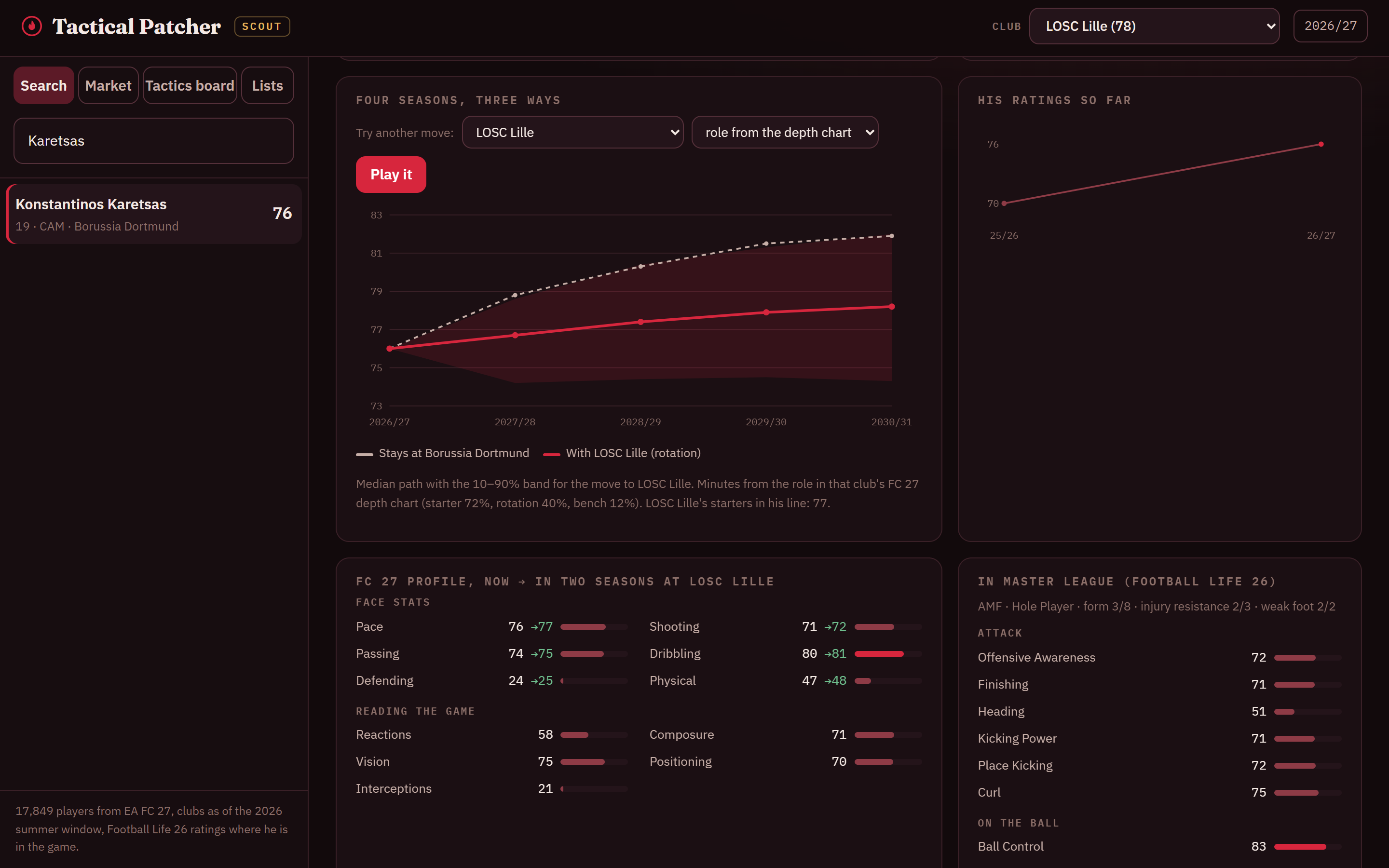
Start from FIFA 19 with only what was known then, play four seasons, compare with FIFA 23. Minutes come from a model of real careers, the club can rise or fall, draws have heavy tails, and the spread for each talent tier is chosen on a second time machine (FIFA 18 to 22).
On the unseen one, 80, 78, 76 and 76 % of real ratings land inside the band, from the under-65s to the 78+. A simulator that keeps each player in his starting role manages 31 to 40 %.
How does an analyst see a player?
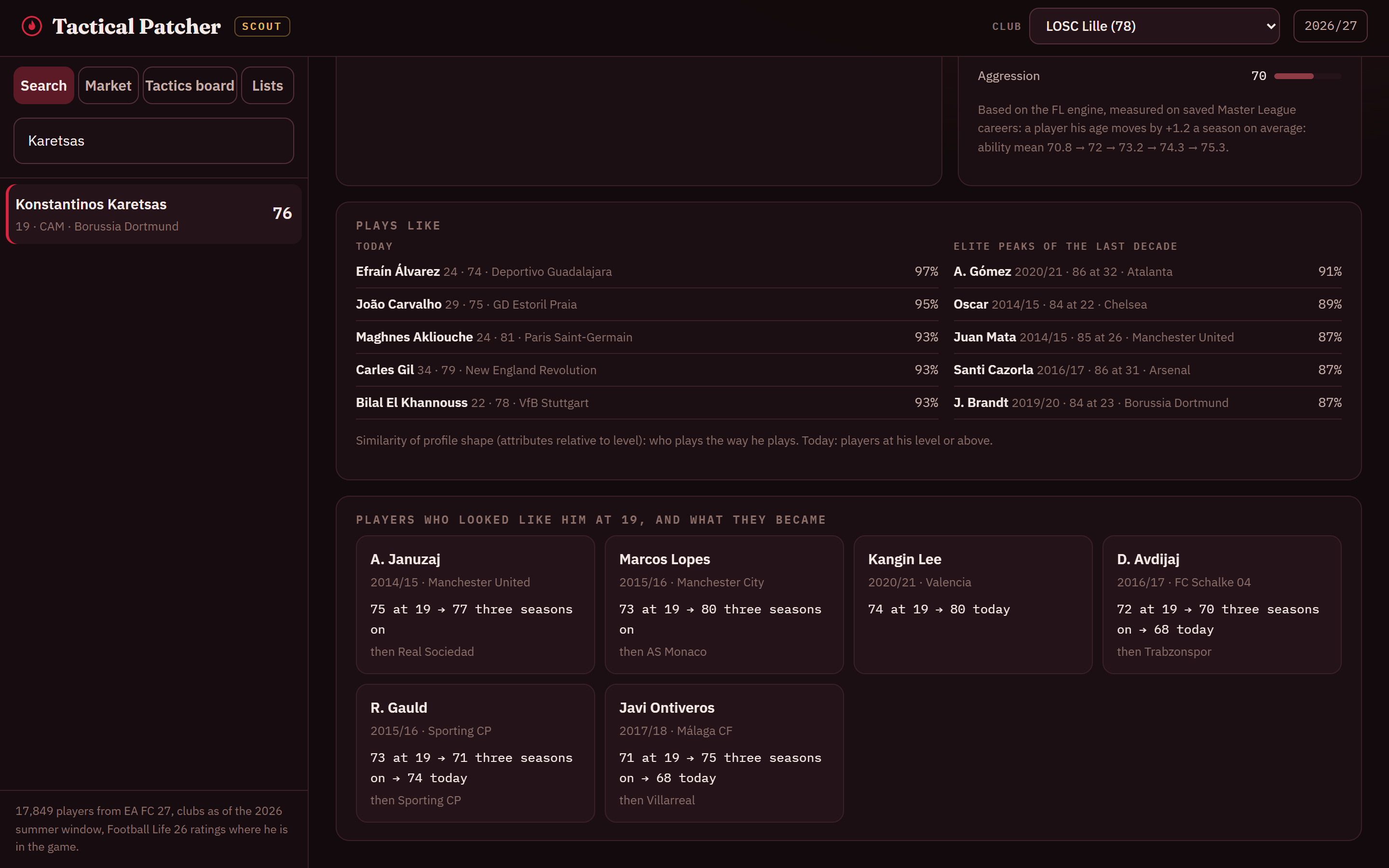
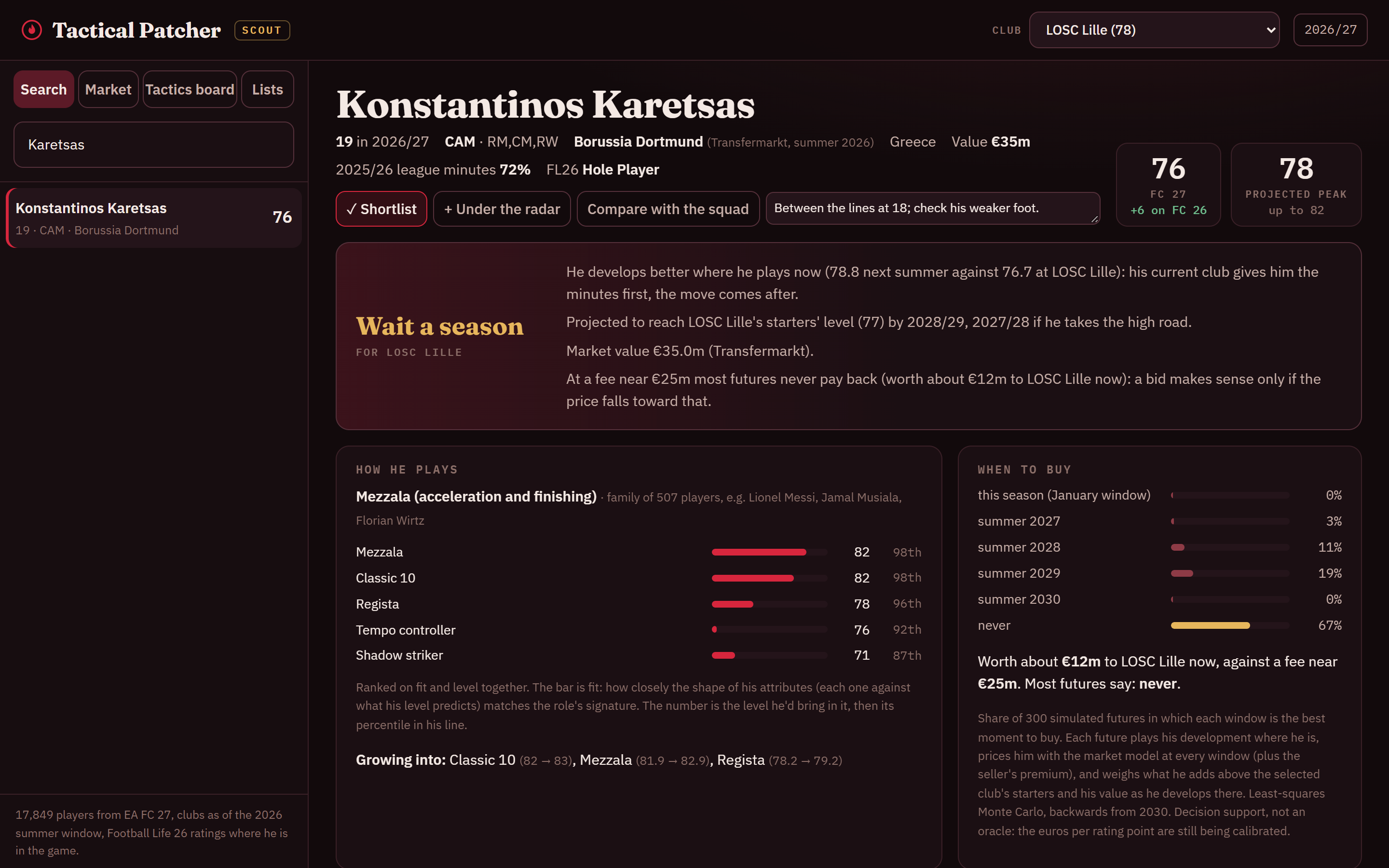
A star is good at everything, so fit is read on the shape of his attributes: each one against what his level predicts. 28 roles as signatures, from regista and mezzala to inverted full-back and channel runner. The archetypes come from the data: Rodri, Caicedo and Tchouaméni land together, and so do Gyökeres, Thuram and Osimhen.
Plays-like compares shapes with today's players at his level or above and with the decade's elite peaks. Karetsas sits with Akliouche and El Khannouss today, and with Papu Gómez's Atalanta season among the peaks; Kees Smit with Jorginho, Kovačić and Pirlo.
The search Master League doesn't have
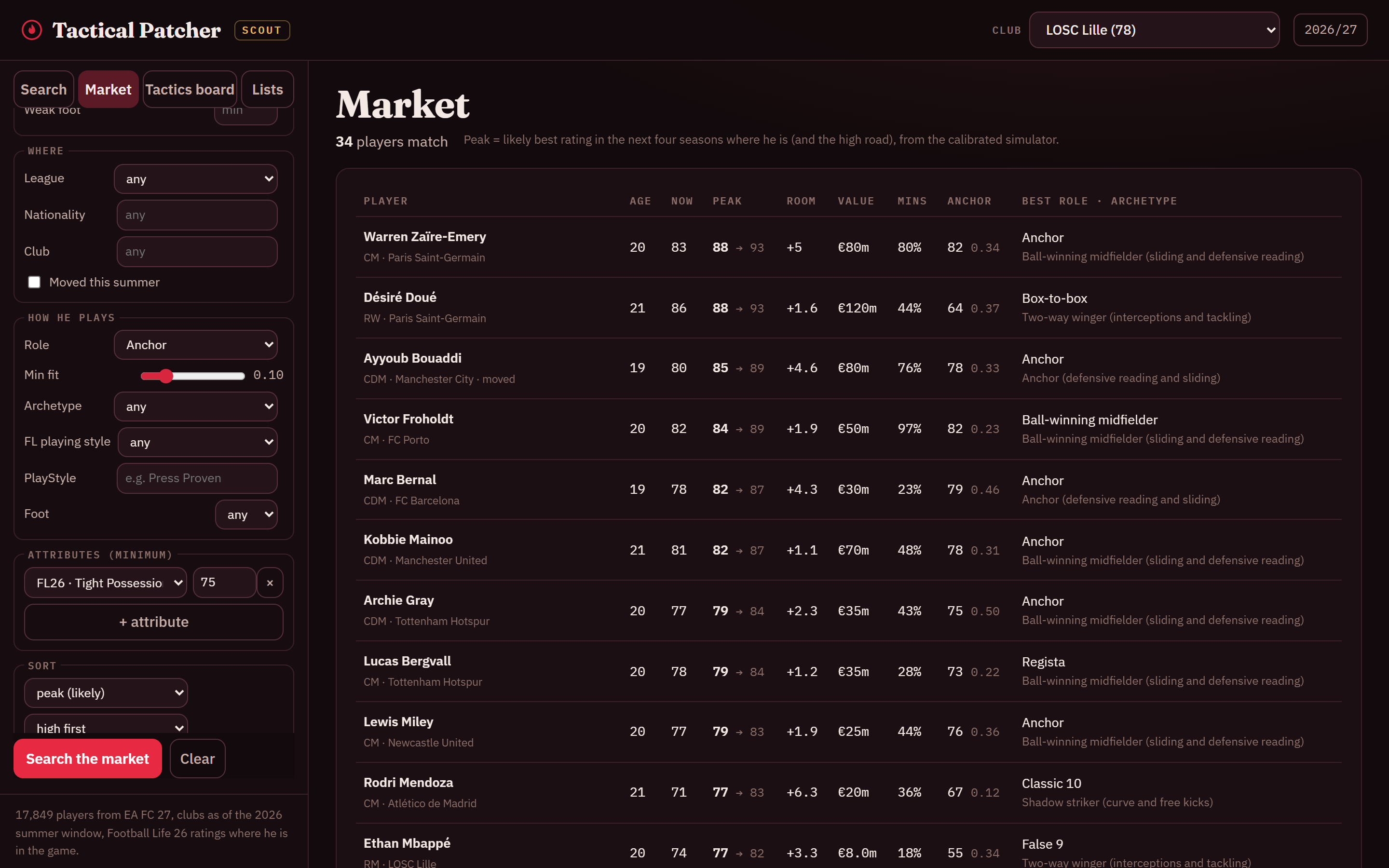
Master League's transfer search filters on age, position and rating. This one adds what a scout asks next: the likely peak and the high road, growth room, peak per million, level in a chosen role and how well his attributes fit it, archetype, Football Life playing style, any attribute minimum.
The tactics board
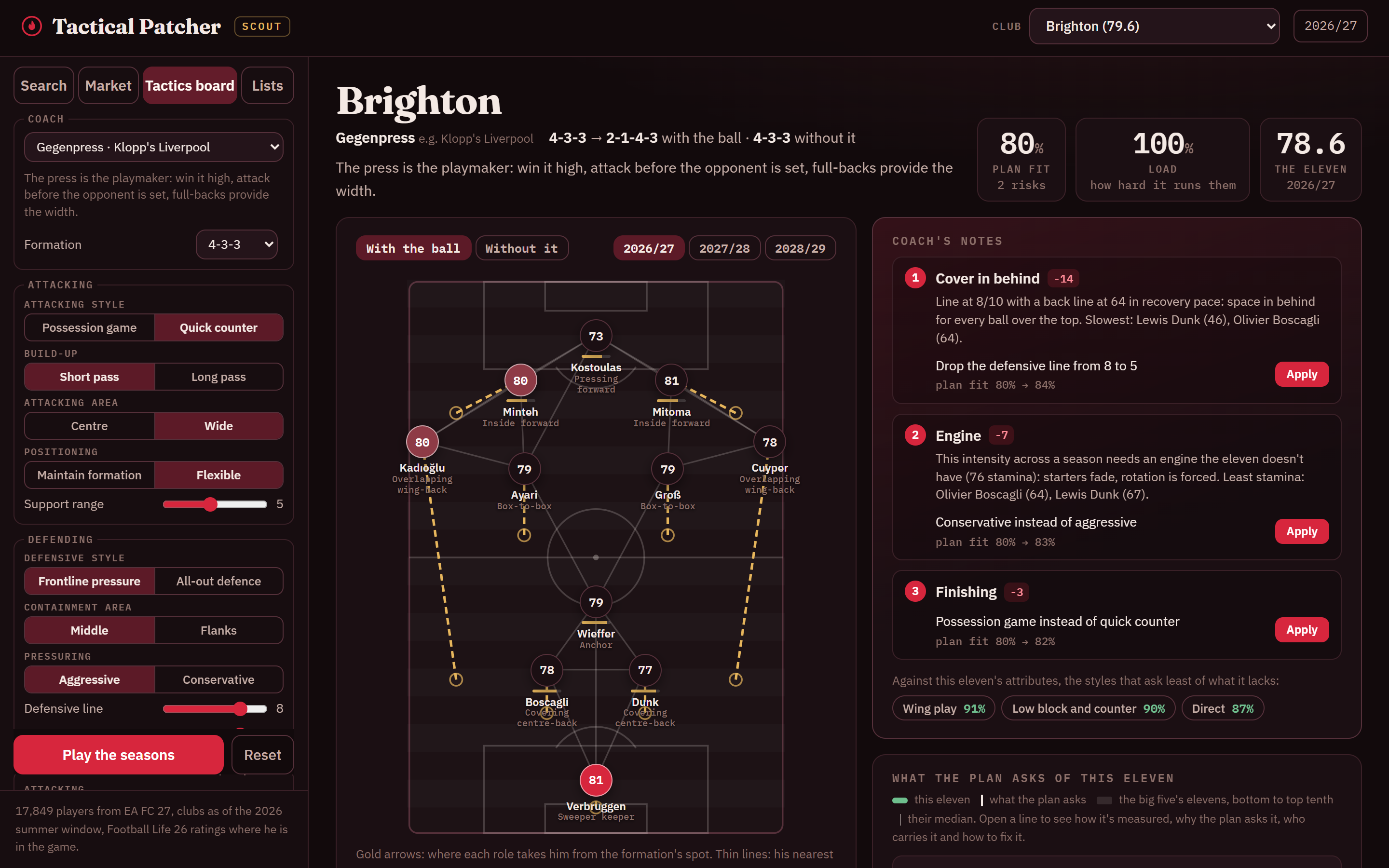
Write a game plan the way PES writes one: attacking and defensive style, build-up, containment, pressuring, line, compactness, two advanced instructions per phase. Or pick a coach's style, from positional play and gegenpress to a low block, and adapt it. Click a player to change his role or who plays there.
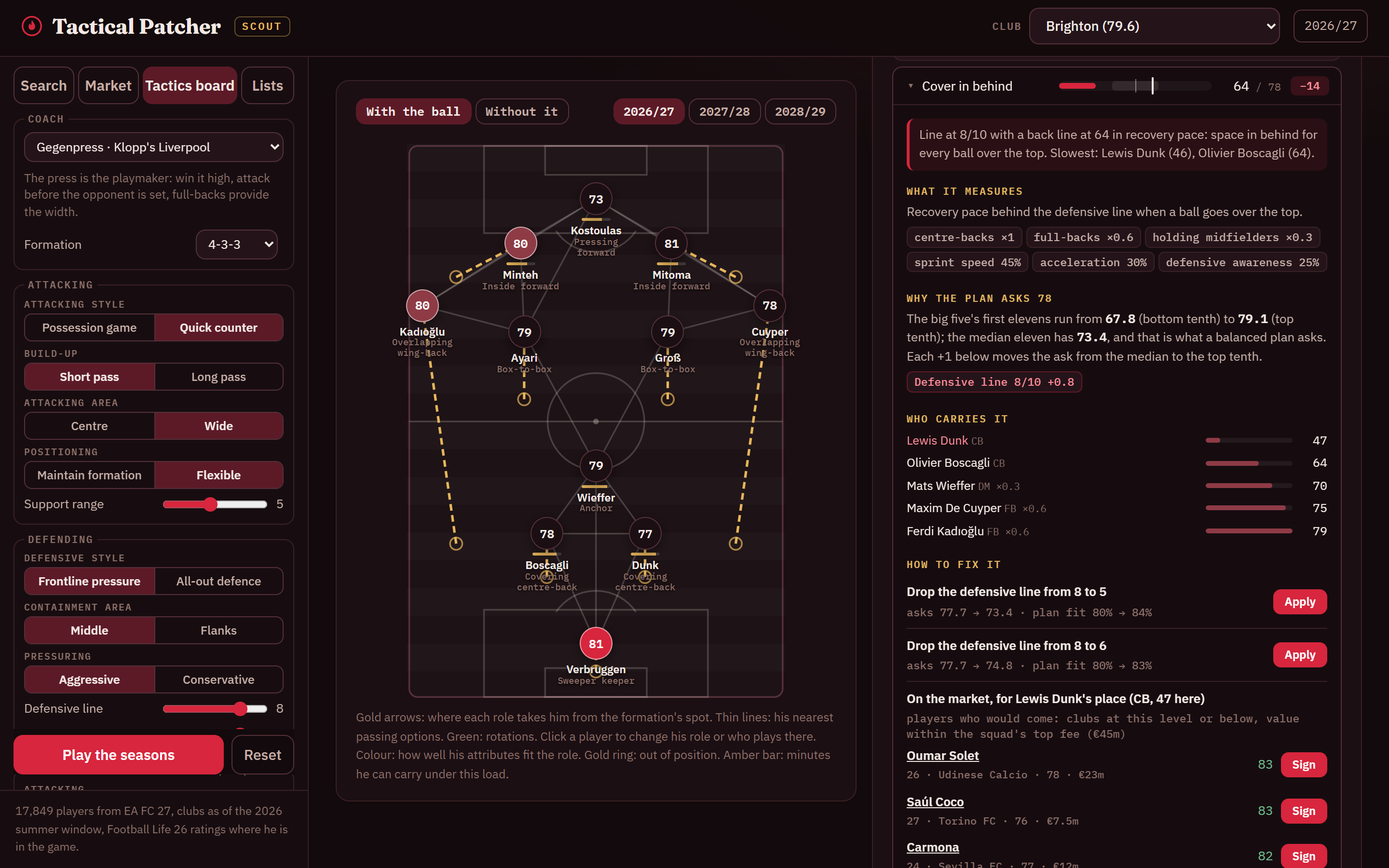
Each role has a movement with the ball and a place without it, and the shapes follow: positional play's 4-3-3 attacks as a 2-3-5 and defends as a 4-3-3 with a 39 m block. Then the plan is read against the eleven: press resistance for a short build-up, recovery pace for a high line, an engine for the press, each set on the spread of the big five's elevens. Liverpool's gegenpress flags Ngumoha's pressing; Brighton's leaves the cover in behind 14 points short; Leverkusen fit a low block at 95 %.
It coaches too. Every demand opens up: what it measures, why the plan asks that number, who carries it, and how to fix it, with fixes worked out rather than written: a one-setting change judged on the whole plan, the squad player who'd lift it most, market targets who would really come. Brighton's gegenpress: drop the line from 8 to 5 and plan fit goes from 80 % to 84 %. One click applies it.
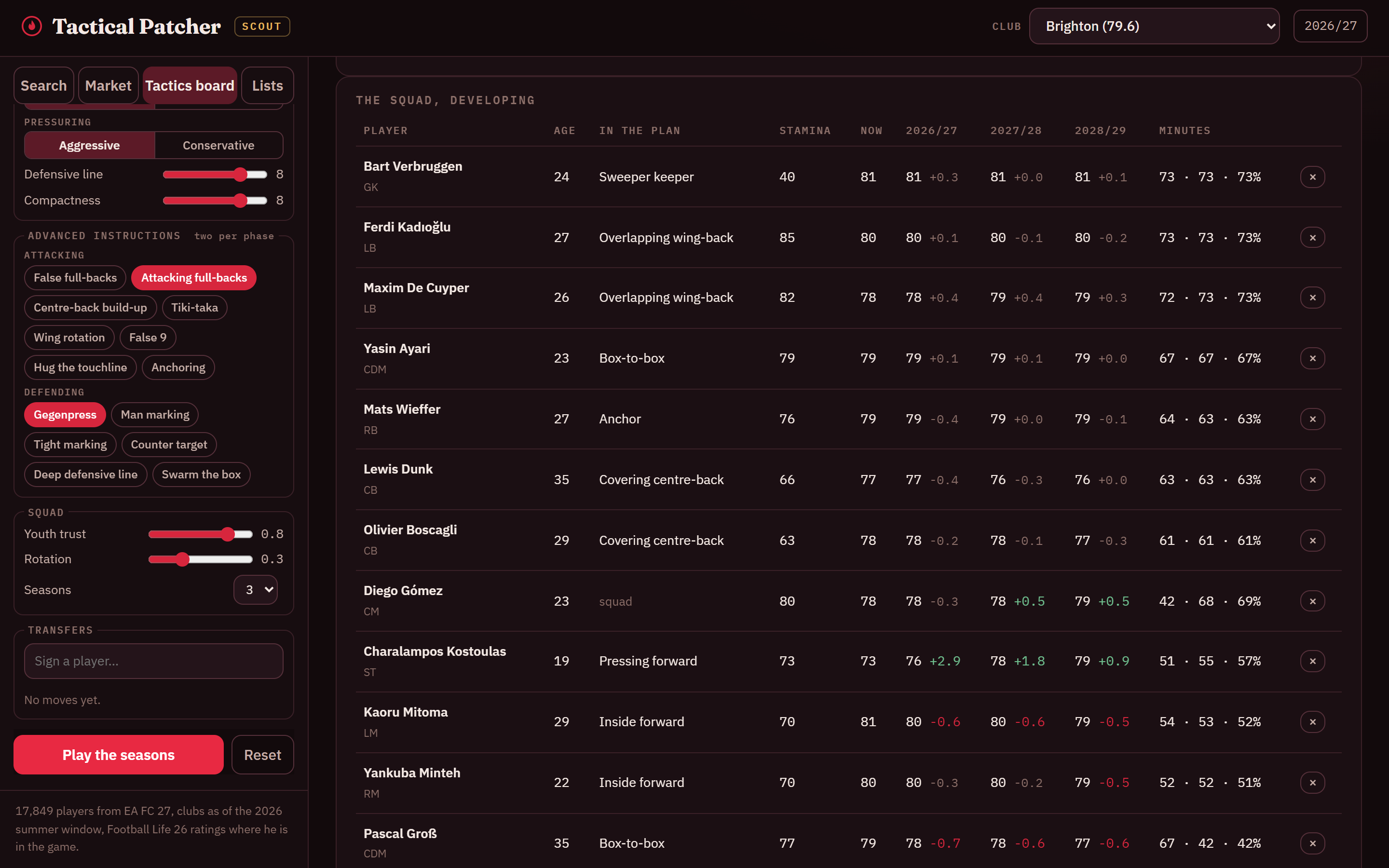
The plan's load caps the minutes a starter can carry, and minutes decide growth. That is the only way tactics touch development: the rules are football knowledge, written down and labelled as rules.
What a rating hides
Kees Smit, starting at AZ, barely moves on EA's scale: 75.0 to 75.6 in four seasons. On Bayern's bench he reaches 81.2. A rating is partly the club's, so a loan is played at a club of the player's own level, never at his parent club's.
Which is where ratings stop: a club's engine needs measures that belong to the player, what he does on match day and in training, and his minutes at level. That is the next project, Promesse.
The outcome
A scout's desk for 17,849 current players: where a player could be in four seasons with you, where he is or on loan, the roles he fits, when to buy and at what price, a market search, scouting lists and side-by-side comparisons, a tactics board that plays a coach's choices forward, and analysis pages on promises, clubs and coaches.
What would come next
- Promesse: the same questions asked by a club, on its own data: scouting grades, physical tests, GPS load, maturation, match events.
- Growth measured on match-day and training-day performance and minutes at level, not on a rating that carries the club's name.
- The academy pipeline from U12 to U19: relative age, maturation and pathway.